

DELTA Informed Decisions × Nintex Partner | Process Insights Series
There is a moment in every transformation journey when leaders realise that optimising isolated processes is not enough.
You can map workflows, improve hand-offs, or even automate key steps — and yet decisions still stall.
Why?
Because improvement without governance is like a well-built machine with no steering.
For years, “governance” has carried an unfortunate reputation: control, restriction, bureaucracy.
But the organisations that succeed in the AI and automation era understand a different truth:
Governance is a systemic approach to collaboration — the structure that turns alignment into action.
When reframed this way, governance becomes less about compliance and more about decision clarity, ensuring the right people, with the right information, make the right decisions at the right time.
Why Governance Needs a Rethink

In fast-paced environments, governance is often reduced to checklists, approvals, or compliance reviews.
But when this is the dominant view, collaboration slows and innovation stagnates.
Modern process governance is different.
It is dynamic, transparent, and participatory. It:
- clarifies ownership
- strengthens accountability
- improves responsiveness
- supports continuous improvement
- aligns technology, people, and decisions
As Whatfix highlights, process governance aligns people, processes, and technology to ensure consistency and accountability — not to restrict innovation, but to enable it.
This shift—from control to collaboration—is the foundation of effective transformation.
Two Paths to Governance: Centre of Excellence or Process Committee
Reframing governance does not mean reinventing it.
It means selecting a governance model that fits your organisation’s maturity, culture, and transformation goals.
Across industries, two proven structures stand out:
1.Centre of Excellence (CoE)
A CoE acts as a central hub for:
- process standards
- enterprise methodology
- best practices
- training and capability building
According to the Process Excellence Network, CoEs accelerate adoption by building internal expertise and providing a consistent foundation for transformation.
CoEs work best when:
- the organisation is large
- process maturity already exists
- consistent cross-enterprise standards are needed
- governance needs centralisation
CoE answers: “How do we keep our standards consistent?”
2.Process Oversight Committee (PoC)
A PoC distributes ownership across teams.
It brings together:
- process owners
- analysts
- senior leaders
- operational representatives
A PoC focuses on:
- alignment
- continuous improvement
- decision cadence
- visibility of process performance
PoCs work best when:
- collaboration is essential
- change fatigue is high
- teams need shared ownership
- decisions must be transparent and timely
PoC answers: “How do we make improvement continuous and visible?”
Both are valid — the right model depends on where your organisation sits on its governance maturity curve.
Making Governance Measurable
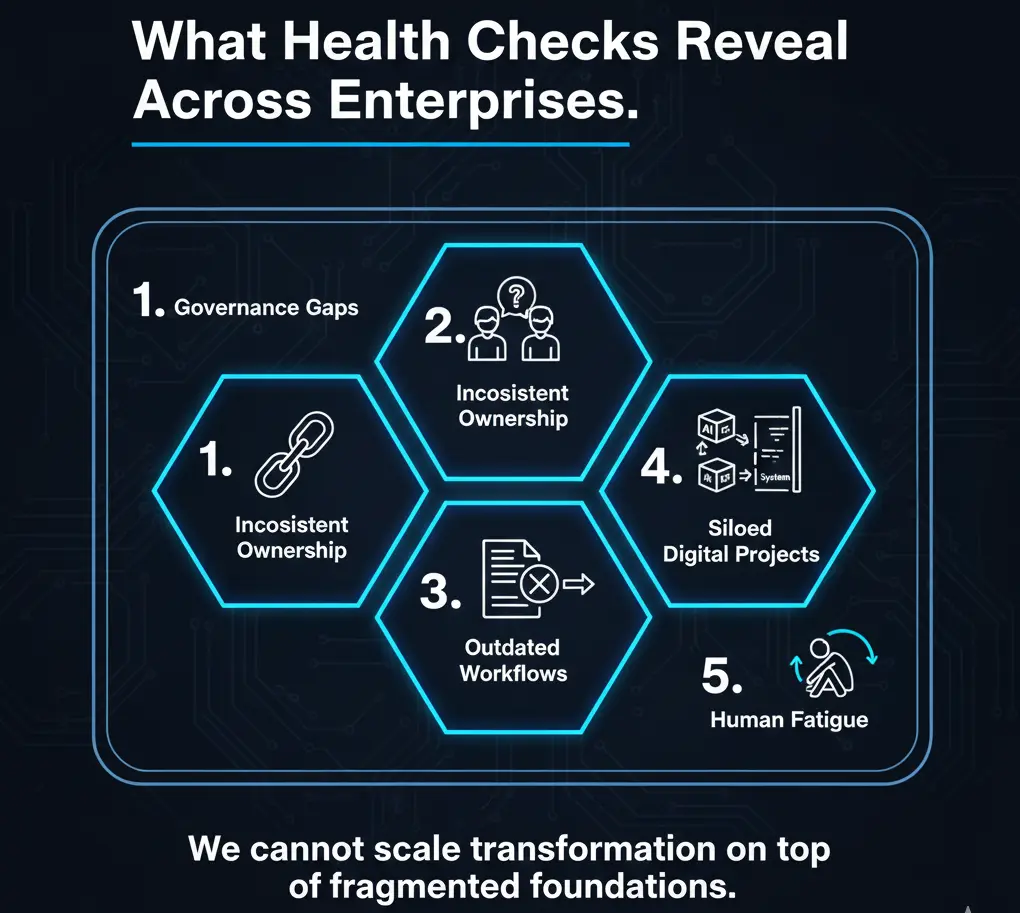
Governance only delivers value when it is measured.
Otherwise, it risks becoming a passive review cycle rather than an enabler of performance.
Oracle’s CoE framework emphasises the importance of measuring:
- cycle time reduction
- forecasting reliability
- cost of ownership
- decision throughput
To translate governance into measurable business value, leaders can adopt a Governance Value Dashboard built across four dimensions:
1. Governance Effectiveness
- % of processes with assigned ownership
- governance cadence completed vs planned
- visibility of decisions and actions
2. Decision Velocity
- average decision cycle time
- % of decisions delivered within SLA
- escalations resolved through governance
3. Value Realisation
- % of improvements implemented
- cost avoidance achieved
- time-to-value for initiatives
4. Continuous Improvement
- number of staff trained in process governance
- maturity index (per business unit)
- compliance with quarterly review cycles
When governance is measured consistently, leaders stop asking,
“How many approvals happened?”
and start asking,
“How much value did we create?”
How Reframed Governance Drives Better Decisions
At DELTA Informed Decisions, we position governance as a decision-enablement mechanism, not an administrative layer.
With clear governance:
- escalation pathways simplify
- decision confidence increases
- accountability becomes visible
- innovation accelerates
- process performance connects directly to business goals
Both CoEs and PoCs serve as decision forums, ensuring the insights generated by process teams translate into prioritised action.
This is the real power of governance reframing:
It shifts leaders from reactive problem-solving to evidence-based leadership.
Practical Takeaways for Leaders
- Define Purpose
Clarify whether governance aims to increase speed, consistency, capability, or alignment. - Choose the Right Governance Model
CoE for standardisation.
PoC for collaboration.
Hybrid for scale. - Establish Governance Cadence
Monthly reviews for operational processes.
Quarterly dashboards for enterprise performance. - Measure What Matters
Use a Governance Value Dashboard to demonstrate progress and ROI. - Celebrate Clarity
Recognise teams that turn visibility into action.
Final Thought
Governance isn’t the enemy of agility — it is the system that makes agility sustainable.
It is how organisations transform collaboration into measurable performance.
When organisations shift from control to collaboration, governance becomes the engine of transformation—building confidence, accelerating decisions,and enabling continuous improvement through effective strategy digital transformation.
At DELTA Informed Decisions, in partnership with Nintex, we help leaders build governance systems that support intelligent transformation across people, processes, and technology.
FAQ
1. What is process governance?
Process governance is the system of structures, responsibilities, and decision-making practices that ensure business processes are accurate, trusted, and continuously improved.
2. Why does governance matter for digital transformation and AI?
AI and automation rely on clear, stable, and standardised processes.
Without governance, digital initiatives accelerate inconsistency instead of improving performance.
3. What is the difference between a Centre of Excellence and a Process Committee?
A CoE centralises expertise and standards; a PoC distributes ownership across teams.
Many organisations adopt a hybrid model to balance consistency and collaboration.