

DELTA Informed Decisions × Nintex Partner | Process Insights Series
In today’s fast-changing environment, organisations across New Zealand, Australia, and APAC are investing heavily in digital transformation, automation, and AI.
Yet in our work with enterprises across sectors, one pattern remains consistent:
process mapping is not transformation.
It is the beginning — not the output — of a successful digital and AI-ready organisation.
Even when teams document processes, without governance, maintenance, and clear ownership, those maps quickly drift from reality.
And organisations with mapped-but-not-maintained processes face nearly the same challenges as those with no documentation at all:
rework, uncertainty, slow decisions, and siloed ways of working.
In the era of automation and AI adoption, these gaps become costly and difficult to reverse.
“If you want automation or AI to succeed — get your house in order first.”
This is the role of a Process Health Check.
Not an audit.
Not a compliance exercise.
But a strategic diagnostic that shows leaders where their process ecosystem is supporting transformation — and where it is silently undermining it.
Why Visibility Falls Behind in Fast-Moving Organisations
Across our enterprise engagement work, we see the same recurring challenges:
- A high percentage of processes become outdated within months
- Cross-team variations make documentation unreliable
- Ownership is unclear or centralised in one “process champion”
- Digital projects run in silos, disconnected from process maturity
- Teams experience transformation fatigue due to constant change
- Leadership lacks visibility into how work actually flows
These challenges directly impact:
- operational efficiency
- automation readiness
- governance maturity
- AI training data quality
- decision cycle time
This is where a Process Health Check becomes essential — it confronts the assumptions that slow transformation and reveals the truth leaders need to make informed decisions.
Mapping Is a Milestone — Maintenance Is the Transformation Discipline
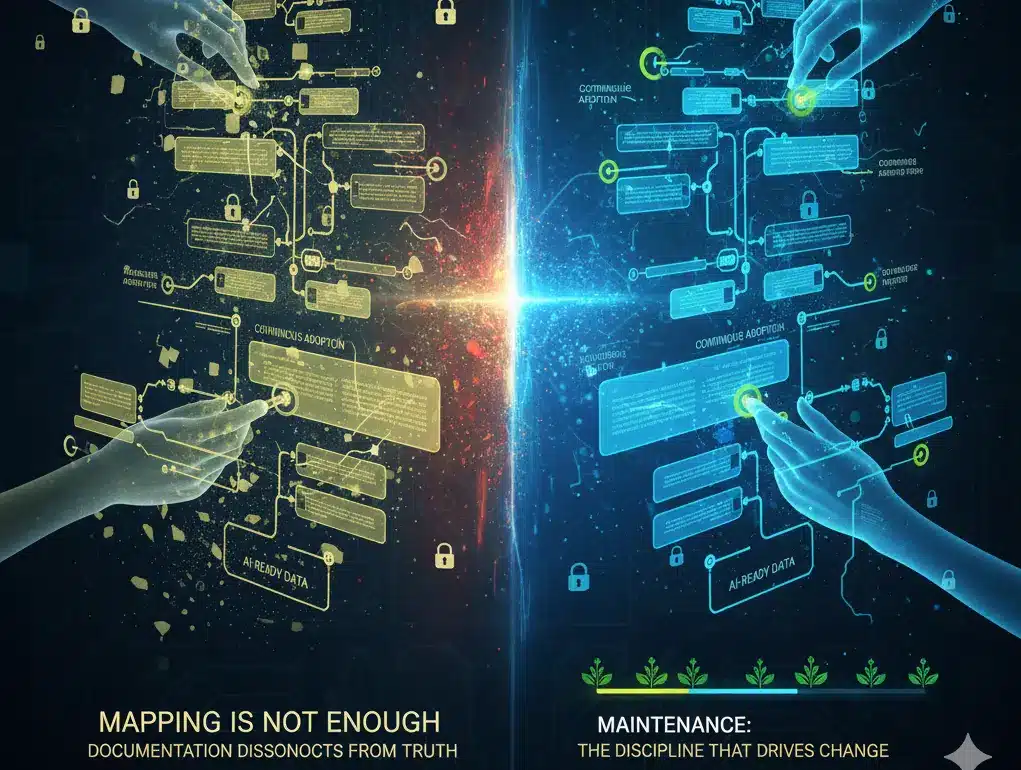
One of the most striking lessons from enterprise Health Checks is this:
Mapping is version 0.1.
Maintenance is where transformation truly begins.
Without a structured maintenance system:
- documentation loses trust
- adoption drops
- variations multiply
- automation becomes risky
- AI cannot rely on inconsistent workflows
A Process Health Check exposes these gaps and transforms them into clear, actionable insights.
What Health Checks Reveal Across Enterprises
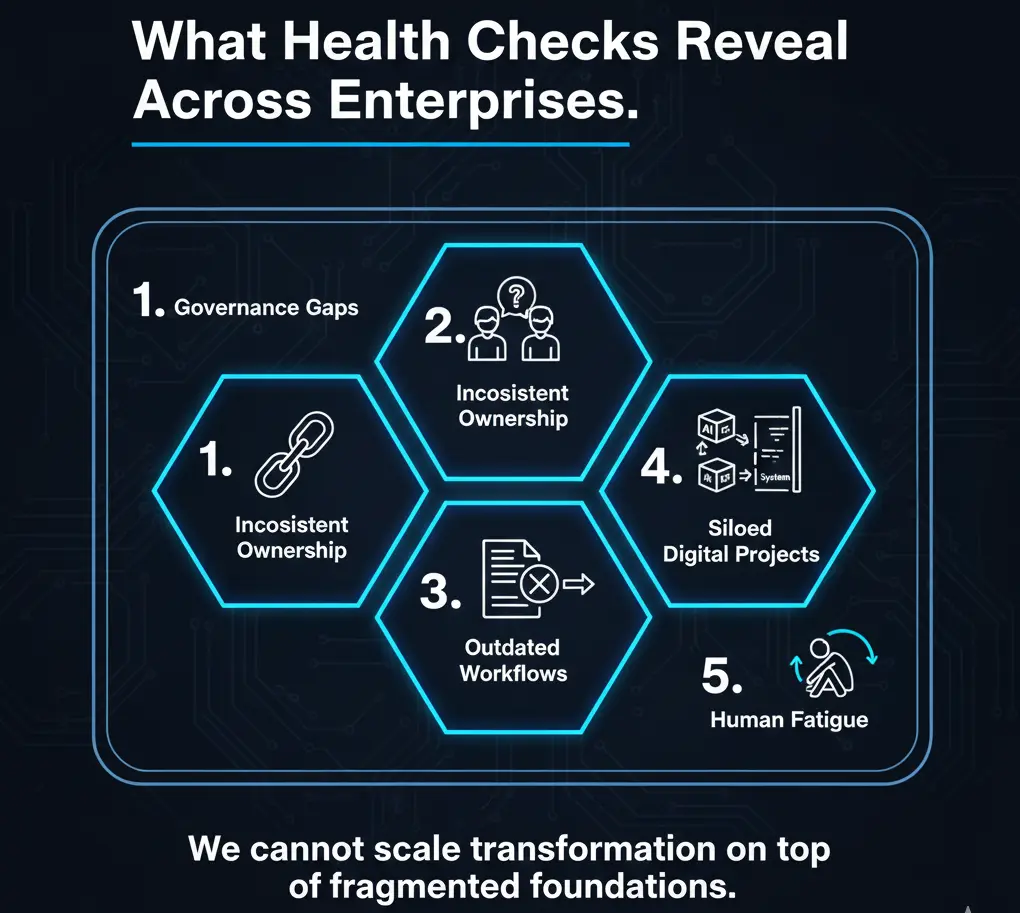
From New Zealand to APAC, our health checks show five consistent themes:
1. Governance Gaps
Most organisations lack a defined governance cadence that keeps process information accurate, visible, and aligned.
2. Inconsistent Ownership
Responsibility for processes is unclear or concentrated in one overwhelmed role.
3. Outdated or Incomplete Processes
Even mature enterprise systems often show 30–60% outdated documentation.
4. Siloed Digital Transformation Workstreams
AI, automation, and system upgrades often move faster than the organisation’s process maturity.
5. High Human Fatigue
Fragmented change creates uncertainty and slows adoption — particularly across frontline and operational teams.
Across all industries, these signals point to one strategic truth:
“You cannot build transformation on fragmented foundations.”
From Diagnosis to Informed Decisions
A Process Health Check transforms complexity into clarity.
It provides leadership with a structured basis for decision-making across five critical areas:
1. Governance Uplift
Clear ownership structure, consistent governance cadence, and a central view of process health.
2. Process Committee or CoE Model
A cross-functional Process Committee (PoC) or Centre of Excellence (CoE) to sustain process quality and accountability.
3. Prioritisation of High-Value Processes
Focus on workflows that drive customer value, risk reduction, compliance, or automation readiness.
4. Correct Sequencing of AI and Automation
Ensuring digital projects start from a stable, standardised foundation.
5. Strengthening Enterprise-Wide Adoption
Bridging the gap between “we have a system” and “we rely on process intelligence for decision-making.”
Across large enterprises, this is the turning point where Health Checks evolve from “documentation reviews” to strategic governance assets.
Why Stabilise Before You Automate
Automation accelerates whatever exists — clarity or chaos.
AI amplifies whatever data it is trained on — accuracy or inconsistency.
When automation or AI is deployed on top of unstable processes, three predictable outcomes emerge:
- Change resistance rises because workflows lack clarity.
- Automation rework increases due to unclear requirements.
- AI outputs become unreliable because input processes are inconsistent.
This is not a technology issue.
This is a process foundation issue.
A Process Health Check stabilises this foundation — reducing risk, protecting investment, and preparing teams for AI-driven decision-making.
Measuring What Matters — Process Health Scorecard
Using the DELTA method and industry benchmarks, a Process Health Check evaluates four essential dimensions:
1. Governance Maturity
- Ownership assigned
- Review cadence established
- Escalation pathways defined
2. Process Accuracy & Completeness
- % outdated
- % missing decision logic
- Alignment with actual practice
3. Engagement & Adoption
- Views and usage metrics
- Review feedback loops
- Cross-team contribution
4. Automation & AI Readiness
- Standardisation level
- Clarity of inputs/outputs
- Data quality available for AI
These indicators provide leaders with a single view of organisational readiness for automation and AI.
Practical Lessons for Leaders
1. Treat mapping as the start — not the end.
Processes evolve; documentation must evolve with them.
2. Use Health Checks to align assumptions with reality.
Leaders need truth, not interpretations.
3. Build governance cadence before scaling automation.
Automation without governance accelerates inconsistency.
4. Measure process health the same way you measure
financial health.
What you measure becomes what improves.
5. Stabilise your foundation before entering the AI era.
AI requires clarity, consistency, and trusted processes.
Final Thought
Across every enterprise we have supported, one truth remains constant:
Process Health determines Transformation Health.
A Process Health Check is a leadership tool — not an operational task.
It reveals whether your organisation is ready to scale, ready to automate, and ready to adopt AI with confidence through effective digital transformation management consulting.
At DELTA Informed Decisions, in partnership with Nintex, we help organisations strengthen their foundations, uplift governance, and transition from fragmented change to confident, informed transformation.
Because before you innovate, automate, or implement AI, one message stands above all:
Get your house in order.
Then everything else becomes easier — and measurable.
FAQ
1. What is a Process Health Check?
A Process Health Check is a structured diagnostic that evaluates the accuracy, completeness, and governance of your organisation’s processes.
It highlights where workflows support transformation — and where outdated or fragmented processes are creating hidden risks, rework, and delays.
2. Why is a Process Health Check important before automation or AI?
Automation and AI amplify whatever foundation you give them.
If your processes are inconsistent, unclear, or out of date, automation will accelerate mistakes and AI will learn from unreliable inputs.
A Health Check ensures your process foundation is stable, accurate, and ready for digital scaling.
3. How often should an organisation conduct a Process Health Check?
Most organisations benefit from a Health Check annually or before any major transformation, including:
- system upgrades
- automation or workflow redesign
- AI adoption pilots
- organisational restructuring
It ensures the process layer stays aligned with real work and upcoming change.